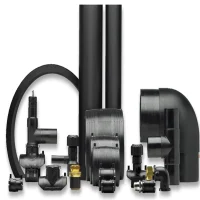
Electrofusion connecting elements
They are made of PE 100 – high-density polyethylene, new generation. After being manufactured, EVERY single electrofusion connecting element undergoes quality control and after successful control is packed in a plastic bag together with a magnetic card on which the measurement data is written. PEHD 100, Polyethylene 100 High Density, is the most widely used plastic material for underground installations in water and gas distribution. Good mechanical properties, very high toughness/plasticity, UV stability and chemical resistance have enabled PEHD material to become one of the most widely used plastic materials for the transport of chemically aggressive media. Pressure-temperature applicability ranges from -40 to +60°C and pressures up to 16 bar. Pipeline connection can be performed by electrofusion, polyfusion or butt welding.
Fusion welding connection
Thanks to the fact that PE materials can be fusion welded (without the use of additional material), joints are made quickly and safely, which, when properly executed, guarantees the tightness of the system. Two main methods of fusion welding are used today:
• butt welding with a hot plate, in which the connecting surfaces of the pipes are heated to the welding temperature using a hot plate and, after moving the hot plate, they are connected by pressure.
• electrofusion welding, which is performed using electrofusion polyethylene fittings, which have an electrical resistance wire built in. By passing current through the wire, the connecting surfaces of the pipe and fitting are heated, creating the pressure necessary for the fusion of the materials.
Both procedures are performed automatically, which reduces the human factor to a minimum.
Electrofusion couplings, like all other electrofusion connecting elements up to a diameter of d 63 mm, have built-in clamps that are used to secure the connecting element to the pipe.
Saddles – a modular system, the base is a ‘saddle without a knife’ which is usually installed on pipelines that are not under pressure and on which other elements are installed as needed, so that we get a saddle with a knife, a saddle with a valve or a saddle for ballooning.
Other electrofusion elements, elbows at an angle of 90° and 45°, T-pieces, reductions, are made with an electrofusion coil (in the electrofusion version) in all the most commonly used dimensions, and the end caps are made in the electrofusion version – with an already installed electrocoil or as a set of cap and electrofusion.